
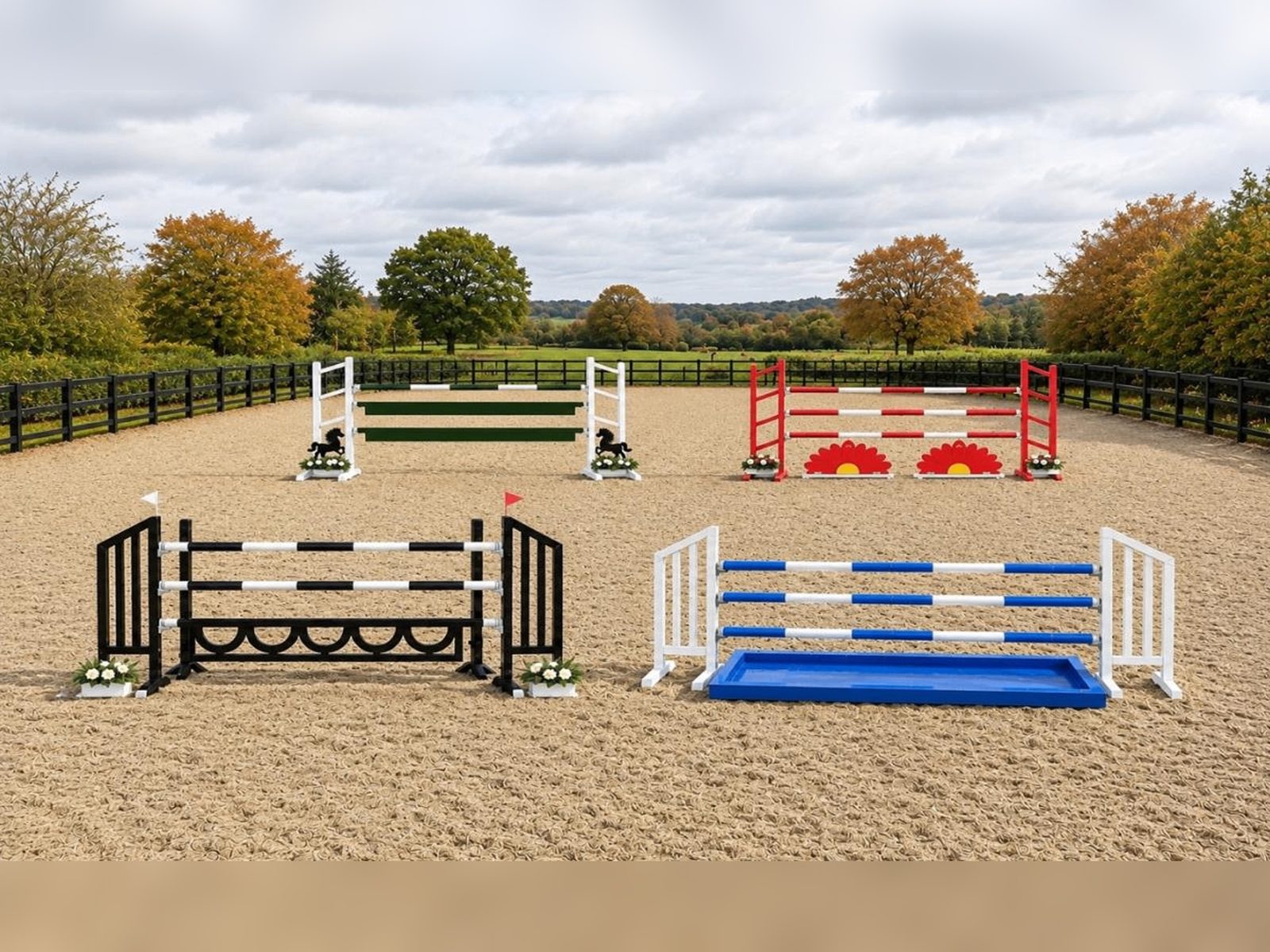
Every product we make is designed to live outdoors and take knocks — but how you put it away between sessions decides whether a set still looks new in five years. This is a product-by-product storage guide for everything in the ProHorseJumps.ie range, from a full arena package down to a bag of sandbags.
The three rules that cover everything. Store it dry, store it off the ground, and store it flat or fully upright — never leaning at an angle under its own weight. Almost every storage problem on a yard comes from breaking one of those three.
Jump to a product
Aluminium wings and uprights
Our wings and uprights are powder-coated aluminium with plastic caps. Aluminium is naturally resistant to rust and corrosion, so unlike timber they do not need to be sheltered to survive — but they do need to be stored in a way that protects the powder coat and keeps them straight.
Stack them face to face. Put two wings together with the painted faces looking at each other, so any rubbing happens between two flat surfaces rather than a foot scraping a painted face.
Keep them vertical or completely flat. A wing leaning at a slant against a wall for months puts constant load on one corner. Either stand them fully upright against a flat wall, or lay them flat in a stack.
Off the ground. Two lengths of timber or a pallet under the stack keeps the feet out of standing water and mud, which is what dulls a powder coat over time.
Check the plastic caps before they go away. A cap that has popped off is the one thing you want to notice now, not in March.
Do not store anything heavy on top of a flat stack of wings. Aluminium is light and strong, but it is not a shelf.
Standard wings are approximately 1.7m and training wings approximately 1.45m — worth knowing before you decide which corner of the shed they live in.
Capped 3m poles
The poles are FEI-standard 3m lightweight timber with plastic end caps. The caps exist to keep water out of the end grain, and that makes storage the single most important part of pole care.
Never leave poles lying on sand or grass. Timber sitting on wet ground draws water in along its whole length. Get them onto a rack, a pair of bearers, or at minimum a pallet.
Support them in at least two places, reasonably far apart. A 3m pole supported only in the middle, or only at the very ends, will take on a bow over a long winter.
Store them flat, not standing on end. Standing a pole vertically puts all its weight on one capped end, which is exactly the point you are trying to protect.
Let them dry before they go away. Wet poles stacked tightly together stay wet for weeks.
Standing fillers and UPVC faces
Standing fillers are aluminium stands with strong UPVC designs — medium fillers are 60cm high and small fillers 45cm. UPVC is the part that carries the look of a jump, so it is worth being fussy about.
Stand them upright, in a row. Fillers nest badly and scuff each other when they are piled up. A row against a wall, each one square on its own feet, is best.
Face to face again. If they must go two deep, turn the printed or coloured faces toward each other.
Nothing leaning against a filler face. A pole or a rake propped against UPVC for a whole winter can leave a mark or a bow in the panel.
Wipe them down first. Dried mud left on a face for months is far harder to remove than mud washed off the day the set comes down.
Out of long-term direct sun where you have the choice — not because they will fail, but because shaded storage keeps colours looking sharper for longer.
Hanging fillers, gates and planks
Hanging fillers
Store them flat, or fully vertical against a flat wall. Never resting on one bottom corner.
Support the full width when laying them flat — a full-length bearer, not a single block in the middle.
Separate them with something soft if you are stacking several, so hardware on one does not sit against the face of the next.
Nylon cups and FEI safety cups
The nylon cups are extra strong and the safety cups are FEI standard — and they are also the easiest things on a yard to lose.
Give them a bucket, box or drawer of their own and count them in. Do not leave them in the wings.
Keep safety cups separate from nylon cups so nobody grabs the wrong one when re-setting a course.
Rinse sand and grit off the safety cups before they go in the box — a clogged safety cup is a safety cup that will not release cleanly.
Check for cracked or splayed cups as you box them and set damaged ones aside to be replaced rather than putting them back into service.
Water trays
The water tray is the one item that must never be put away wet or full.
Empty it completely, then tip it to drain the last of the water out of the corners.
Let it dry fully before it is stored — a sealed damp tray is how you get staining and smell.
Store it flat and level. Standing a tray on its edge or leaning it against a wall over a winter can put a permanent twist in it.
Heavy-Duty and Compact Tack Lockers
The lockers are stainless steel with a powder-coated finish and 6-inch inflatable wheels. They are storage themselves — but they still need thought about how and where they stand, and what goes inside.
Where the locker stands
On a firm, level surface. A locker parked on soft or uneven ground puts an uneven load through the wheels and makes drawers feel stiff.
Wheels inflated. Check them before you move it, not while you are moving it.
Doors and drawers closed when it is not in use — the finish does far better than an open door catching every knock in a busy aisle.
What goes inside
Nothing wet. Wet rugs, boots and bandages inside a closed steel locker will make everything in there damp. Dry first, then store.
Heaviest items in the bottom drawer. It keeps the locker stable when it is being wheeled and takes strain off the sliding drawers.
Saddles on the saddle racks, bridles on the bridle racks — the racks hold their shape properly, a drawer does not.
Use the three sliding drawers for grooming kit and consumables and keep the loading light enough that they run freely.
For planning a space: the Heavy-Duty Tack Locker is 129 x 119 x 62cm externally and 127 x 117 x 60cm internally
Winter versus in-season storage
Two different jobs, two different standards.
SituationWhat matters mostBetween schooling sessionsPoles off the sand, cups boxed, sandbags flat, water tray emptied. Wings and fillers can stay out — aluminium and UPVC handle Irish weather.Off-season / winterFull clean, full dry, everything off the ground, sorted by component, damaged parts listed for replacement.Travelling to a showFaces protected from each other, poles supported along their length, cups and pins in a sealed box, locker drawers loaded heavy-at-the-bottom.
Aluminium and UPVC mean you are not fighting rot and rust the way you would with timber jumps — no annual sanding, no re-painting, no rotten feet after a wet winter. Storage here is about protecting finish, keeping components straight and knowing that a full set is still a full set when it comes back out.
Questions about a set for your arena?
Message us on WhatsApp and we'll talk through what suits your arena, and delivery or collection anywhere in Ireland.